Mastering Game Designer Skills: Visual Aesthetics, Onboarding Vectors, and Responsive Web Presentation
In the rapidly evolving landscape of interactive entertainment, the role of a game designer has expanded far beyond simple mechanics and narrative structure. Today, a proficient game designer must possess a hybrid skill set that bridges creative artistry, technical understanding, and user experience design. Whether you are an aspiring developer building your first portfolio or a studio lead streamlining your team's workflow, understanding the intersection of visual aesthetics, onboarding processes, and responsive web presentation is critical. This comprehensive guide explores these essential game designer skills, focusing on how modern vector templates and digital assets can elevate both game project creation and professional self-presentation.
The Foundation: Core Game Designer Skills in the Modern Era
When discussing game designer skills, it is common to focus exclusively on coding languages like C# or C++, or engines such as Unity and Unreal. While technical proficiency is vital, the industry increasingly values designers who understand the holistic player journey. This includes the ability to conceptualize visual aesthetics that support gameplay, design intuitive onboarding experiences that retain players, and communicate these ideas effectively through professional web platforms.
A modern game designer acts as a translator between abstract concepts and tangible user experiences. This requires a deep understanding of visual communication. For instance, when creating a game project, the designer must consider how color theory influences player emotion and navigation. Similarly, when presenting these projects to potential employers or clients, the designer must apply those same principles to their personal website or portfolio. The skills used to guide a player through a tutorial level are remarkably similar to the skills needed to guide a recruiter through a digital portfolio.
Visual Aesthetics in Game Project Creation
Visual aesthetics are not merely about making a game look "pretty"; they are a functional component of game design. Aesthetics serve as the primary feedback mechanism for players, signaling interactivity, danger, safety, and progression. Understanding this concept from the ground up is essential for any designer utilizing resources like onboarding vector templates.
Consider the RGB color concept. In digital game design, RGB (Red, Green, Blue) is the additive color model used for screen displays. However, a skilled designer understands that RGB values carry semantic weight. High-saturation reds might indicate health packs or enemies, while cool blues often signify mana or safe zones. When working with vector templates for game UI or onboarding screens, designers must manipulate these RGB values to ensure accessibility and clarity across different devices.
Furthermore, visual aesthetics encompass composition and hierarchy. In a game project creation workflow, using scalable vector graphics ensures that UI elements remain crisp whether viewed on a mobile phone or a 4K monitor. This scalability is crucial for maintaining immersion. If a player struggles to read text or identify icons because of poor resolution or bad contrast ratios, the aesthetic failure becomes a gameplay failure.
Streamlining Development with Onboarding Vector Templates
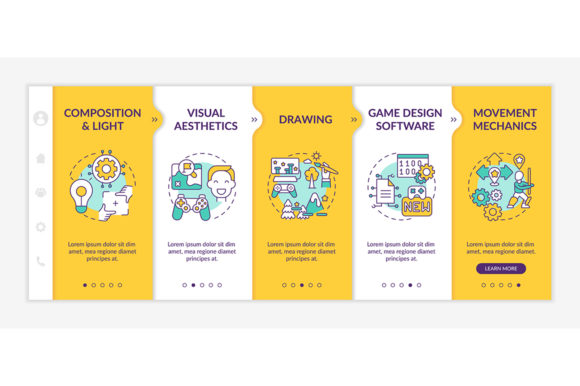
One of the most significant challenges in game development is creating effective onboarding—the process of teaching players how to play without overwhelming them. This is where specialized assets, such as a game designer skills onboarding vector template, become invaluable tools for both learning and production.
The Purpose and Significance of Vector Assets
Vector templates provide a structured foundation for designing user interfaces and tutorial systems. Unlike raster images, vectors are mathematically defined, allowing for infinite resizing without quality loss. For a game designer, this means faster iteration cycles. Instead of drawing every icon and screen frame from scratch, designers can utilize pre-made templates to prototype walkthrough step screens rapidly.
These templates often come packaged in versatile formats. A standard professional asset pack will typically include a ZIP file containing EPS, JPG, PNG, and SVG formats. Understanding when to use each format is a specific technical skill:
- EPS (Encapsulated PostScript): Ideal for editing in Adobe Illustrator or similar vector software. This is your master source file for making structural changes to the template.
- SVG (Scalable Vector Graphics): The web and modern UI standard. SVGs are code-based vectors that render perfectly on responsive mobile websites and within game engines that support vector UI.
- PNG (Portable Network Graphics): Best for static assets requiring transparency. Useful for exporting specific icons or UI elements for immediate implementation in a game engine.
- JPG (Joint Photographic Experts Group): Suitable for complex background textures or preview thumbnails where transparency is not required and file size needs to be minimized.
Designing Webpage Walkthrough Step Screens
Onboarding vector templates are frequently used to create webpage walkthrough step screens. These are sequential visual guides that explain features, controls, or lore before gameplay begins. In a professional context, these same templates can be repurposed to create case studies for a portfolio website.
For example, a designer might use a vector template to illustrate a three-step combat tutorial in their game. Later, they could adapt that exact same visual framework to explain their design process on their portfolio site. This consistency reinforces the designer’s brand identity and demonstrates mastery over visual storytelling tools. It shows that the designer understands how to break down complex information into digestible, visually appealing steps—a core competency in both education and game design.
Responsive Mobile Websites and Iconography
In today’s digital ecosystem, a game designer’s web presence must be flawless across all devices. With mobile traffic dominating web usage, having a responsive mobile website with icons is non-negotiable. This requirement ties directly back to game design principles regarding user interface and adaptability.
The Role of Icons in User Experience
Icons are the universal language of digital interaction. In game design, icons convey inventory items, abilities, and map markers instantly. On a responsive website, they serve as navigation anchors and visual cues. Using vector-based icon sets ensures that these symbols remain sharp on high-density mobile screens (Retina displays) while keeping load times low.
A common misunderstanding among beginners is that more detail equals better design. In reality, effective iconography relies on simplicity and recognition. When selecting or customizing icons from a vector template pack, designers should prioritize clarity over ornamentation. An icon that looks intricate at 500 pixels may become an unrecognizable blob at 32 pixels on a mobile navigation bar. Testing icons at multiple sizes is a practical exercise in empathy, forcing the designer to view their work through the user's perspective.
Integrating Assets into Responsive Frameworks
Building a responsive site involves more than just flexible grids; it requires asset optimization. The SVG files mentioned earlier are particularly powerful here because they can be styled with CSS. A game designer can change the color of an SVG icon on hover or animate it based on scroll position without needing additional image files. This dynamic capability mirrors the interactive nature of games themselves, making the portfolio feel alive and engaging rather than static.
Moreover, responsive design teaches constraints. Just as a mobile game must perform well on limited hardware, a responsive website must deliver content efficiently. Learning to manage file sizes, optimize vector paths, and implement lazy loading for images are transferable technical skills that directly benefit game optimization workflows.
Practical Application: From Asset Pack to Finished Product
To truly internalize these concepts, one must move beyond theory and engage in practical application. Let us explore a hypothetical workflow that integrates all the elements discussed: visual aesthetics, onboarding templates, RGB concepts, and responsive web design.
- Acquisition and Organization: Download the ZIP file containing the vector assets. Extract the contents and organize them by type (EPS for editing, SVG for web/UI, PNG for fallbacks). Establish a naming convention that aligns with both web development standards and game engine import settings.
- Customization via RGB: Open the EPS files in a vector editor. Adjust the RGB color palette to match your specific game project or personal brand. Ensure sufficient contrast ratios for accessibility compliance (WCAG standards), which is increasingly important in both web and game industries.
- Prototyping Walkthroughs: Use the template layers to construct webpage walkthrough step screens. Focus on flow and pacing. Does the sequence logically guide the viewer? Are the icons intuitive? Test this flow on both desktop and mobile viewports.
- Implementation: Export optimized SVGs for your responsive website. Integrate them into your HTML/CSS framework. Simultaneously, export high-resolution PNGs for your game design document or pitch deck. This dual-output approach maximizes the value of the original asset pack.
- Iteration and Feedback: Share your responsive site and game prototypes with peers. Gather feedback specifically on visual clarity and onboarding effectiveness. Use this data to refine both your web presence and your game design skills.
Building a Broader Understanding of Design Versatility
Ultimately, the synergy between game designer skills and web presentation assets represents a broader shift in the creative industry. We are moving away from siloed disciplines toward integrated design thinking. The ability to leverage a game designer skills onboarding vector template is not just about saving time; it is about adopting a systematic approach to visual problem-solving.
By mastering the nuances of RGB color concepts, understanding the technical differences between EPS, JPG, PNG, and SVG, and applying responsive design principles to both games and websites, designers build a robust foundation for success. These skills enhance employability, improve project quality, and foster a deeper appreciation for the user experience. Whether you are crafting the next indie hit or designing a portfolio to land your dream job, remember that great design is intentional, accessible, and adaptable. Embrace these tools not as shortcuts, but as building blocks for your unique creative vision.