Forest Game Background: Cartoon Woodland Assets
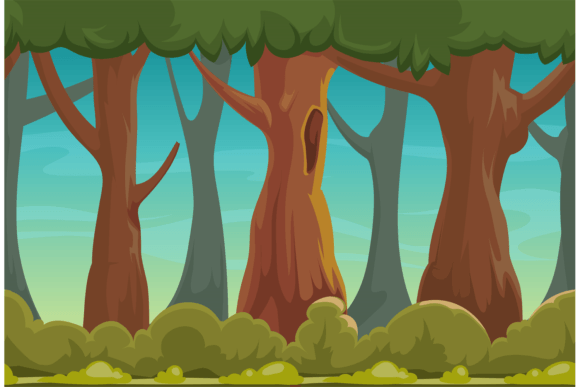
Creating an immersive digital environment starts with the right visual foundation, and few assets set a tone as effectively as a dedicated Forest Game Background. Cartoon Woodland scenes offer a distinct blend of nostalgia, playfulness, and clarity that realistic textures often fail to achieve. For game developers, indie designers, and content creators, this specific style of vector illustration serves as more than just decoration; it acts as a functional interface element that guides player attention and establishes narrative context without demanding excessive cognitive load.
The appeal of a cartoon woodland landscape scene lies in its stylized simplicity. Unlike photorealistic forests that can become visually noisy and distract from gameplay mechanics, cartoon backgrounds utilize clean lines, vibrant color palettes, and recognizable silhouettes. This aesthetic creates immediate visual hierarchy. Players instinctively understand where the ground plane is, which trees are decorative, and where interactive elements might be hidden. Whether you are working with EPS, JPG, or SVG formats, the scalability of these vector-based illustrations ensures that your art remains crisp on everything from mobile screens to large-format promotional banners.
Defining the Visual Personality of Stylized Nature
When evaluating design assets for a project, understanding the personality of the background is crucial. A Forest Game Background. Cartoon Woodland typically features exaggerated proportions, rounded organic shapes, and a saturated color theory that leans toward warmth and safety. This is not the dark, foreboding forest of a survival horror title; it is the inviting grove of an adventure platformer or a cozy farming simulator. The visual language communicates accessibility, making it ideal for family-friendly titles, educational apps, and casual mobile games targeting broad demographics.
From a technical perspective, the vector nature of these assets provides immense flexibility. Because they are constructed from mathematical paths rather than pixels, you can scale a cartoon woodland landscape scene infinitely without degradation. This is particularly valuable for responsive web design and cross-platform game development. You might use the same master SVG file for an in-game parallax layer, a Steam capsule image, and a printed convention banner. The consistency across these touchpoints reinforces brand identity and ensures a professional polish that raster images struggle to maintain at varying resolutions.
The stylistic choices in these backgrounds also influence emotional engagement. Soft edges and lush greens trigger associations with growth, exploration, and tranquility. For marketers and publishers, leveraging this aesthetic in social media graphics or packaging design can instantly signal the genre and mood of the product before a single word of copy is read. It acts as a visual shorthand, reducing friction between discovery and interest.
Strategic Applications Across Digital and Print Media
Versatility is the hallmark of premium design assets, and cartoon forest backgrounds excel in diverse environments. In game development, they serve as the primary canvas for UI overlays. The relatively uniform texture of a stylized forest allows text, buttons, and HUD elements to stand out clearly. When designing menus or inventory screens, the background must support readability rather than compete with it. The controlled contrast in cartoon woodland art ensures that white or light-colored typography maintains high legibility scores, which is essential for user experience and accessibility compliance.
Beyond gaming, these illustrations find strong utility in editorial design and children’s publishing. Book covers, chapter headers, and activity books benefit from the whimsical yet structured nature of vector woodlands. For bloggers and content creators focusing on outdoor themes, sustainability, or parenting, using a Forest Game Background. Cartoon Woodland as a header image or sidebar graphic adds a layer of custom branding that stock photography often lacks. It signals creativity and intentionality, distinguishing personal brands from generic corporate aesthetics.
Commercial applications extend to merchandise and packaging as well. The clean separation of layers in EPS or SVG files allows designers to isolate specific elements—like a singular tree, mushroom, or animal character—for use on stickers, apparel, or product labels. This modularity transforms a single background purchase into a comprehensive design system. Small business owners can create cohesive unboxing experiences or limited-edition product wraps that align perfectly with their digital presence, creating a unified brand ecosystem.
Technical Considerations for Vector Integration
Selecting the right asset requires looking beyond the thumbnail preview. When sourcing a cartoon woodland landscape scene, prioritize file organization. A well-structured vector file will have grouped layers labeled logically (e.g., "Foreground," "Midground," "Sky," "Foliage"). This saves hours of untangling complex paths and allows for easy recoloring to match your specific brand palette. If you are integrating this into a game engine like Unity or Godot, check if the asset includes sliced sprites or tilemaps optimized for performance.
Color management is another critical factor. Vector illustrations created for print may use CMYK profiles, while digital projects require RGB. Ensure the asset you choose supports your output medium or is easily convertible without significant color shifting. For web-based projects, SVG is generally superior to JPG due to smaller file sizes and resolution independence. However, if the cartoon forest contains complex gradients or noise textures, a highly compressed JPG or WebP might actually perform better than a code-heavy SVG. Always test rendering performance on target devices before finalizing your asset pipeline.
Licensing is the final pillar of professional asset usage. Just as you would verify the commercial license for a premium font or display typeface, you must confirm the usage rights for graphical assets. Some licenses cover personal projects but restrict commercial monetization or limit the number of end products. For entrepreneurs and publishers, securing a comprehensive commercial license protects against future legal complications. Treat your visual assets with the same diligence as your software stack; they are foundational components of your intellectual property.
Enhancing Brand Cohesion Through Environmental Art
The most successful creative projects treat background art as an extension of their typography and logo design. A Forest Game Background. Cartoon Woodland should harmonize with your chosen typefaces. Rounded, handwritten fonts pair naturally with soft, organic vector trees, reinforcing a playful tone. Conversely, pairing the same background with a sharp, modern sans serif can create an interesting juxtaposition suitable for contemporary eco-brands or tech-forward nature apps. Testing these combinations early prevents visual dissonance.
Consistency builds recognition. If you use a specific cartoon woodland style for your game, carry those exact colors, line weights, and shading techniques into your marketing materials. Create a style guide based on the background asset. Define the hex codes used in the foliage, the stroke width of the branches, and the opacity of the shadows. When your audience sees these visual cues in an Instagram ad or an email newsletter, they should immediately associate them with your product. This level of brand discipline separates hobbyist projects from professional commercial endeavors.
Ultimately, the value of a cartoon forest background lies in its ability to solve multiple design problems simultaneously. It provides atmosphere, establishes scale, supports UI functionality, and offers scalable marketing assets. By approaching the selection and implementation of these vectors with strategic intent, designers and creators can build richer, more engaging worlds that resonate deeply with their audience. Whether for a mobile game, a children's book, or a lifestyle brand, the right woodland scene is a powerful tool in the modern creative arsenal.